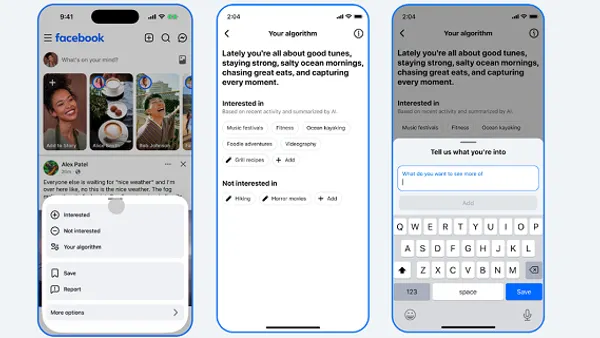
Facebook has launched an algorithm control option that will let users tell the system what they want to see in the app using plain language.
The feature builds on Facebook’s existing Your Algorithm control option, and enables users to either add or remove specific topics from what the system thinks they’re interested in. Users can also tell the algorithm what they like via the tool’s new chatbot prompt.
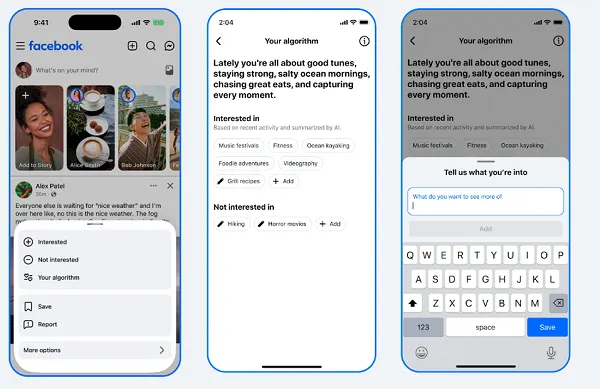
As shown in this image, Meta’s system will refine its algorithmic system based on this user-provided guidance.
Facebook said that the updated option will be available in both the main feed and in Reels, and the system will respond immediately to any changes.
The app is also rolling out a new algorithmic refinement that will ask follow-up questions when users indicate whether they’re interested or not interested in a post.
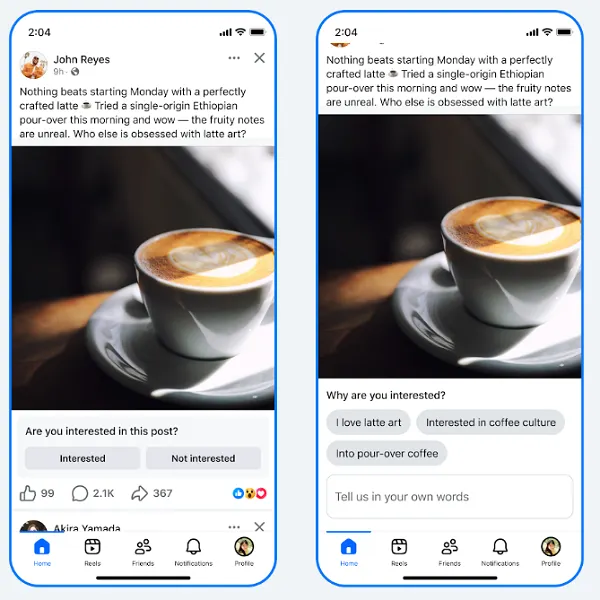
As explained by Facebook: “After clicking ‘Interested’ or ‘Not interested,’ we may ask follow-up questions for more detail on what you liked or disliked. You can easily tell us, in your own words, what you want to see more or less of, and your recommendations will update in real time. It’s a more direct, conversational way to shape your experience.”
The updated system was built using Meta’s latest artificial intelligence-powered guidance, which is now designed to understand human language prompts.
“LLMs can incorporate the interests, context, and intent behind natural language, unlocking an algorithm you can actually talk to,” Facebook said. “Tell it what you want more or less of, and your recommendations respond in real time, adapting within the same session to reflect what matters to you right now.”
Conceptually, that should enable Meta’s various app systems to more effectively respond to feedback and help improve each user’s experience.
Assuming they use it, that is.
Part of the challenge for Facebook in particular is convincing people to implement manual changes and explore their app settings. For example, users can already change their Facebook feeds to display a reverse chronological order via existing settings, yet this remains one of the most requested feature updates.
That said, users can’t make a reverse chronological feed the default, and their app will revert to an algorithm-defined setting every time they exit and return to the platform. However, there are still various settings available within Facebook’s controls that do address many core concerns and issues. Yet, historically, Facebook users don’t make changes to their settings, even when there’s a significant reason for them to do so.
Another example came amid concerns about data misuse in the wake of the Cambridge Analytica scandal. At the time, reports suggested that Facebook users were deleting their accounts en masse. That didn’t happen, and Facebook itself reported no significant shifts in user behavior.
According to reporting from ZDNet, the vast majority of social media users never update their privacy settings, while the Washington Post reported in 2024 that only a fraction of parents ever implement control options to manage their kids’ social app usage.
People say they don’t like how certain elements of Facebook work, but they also don’t appear to want to make any effort to refine their own settings. Instead, users seemingly prefer to complain about such issues and hope that Meta sorts it out.
But there are options, such as these updated algorithm settings, which could help to refine and improve the Facebook experience.