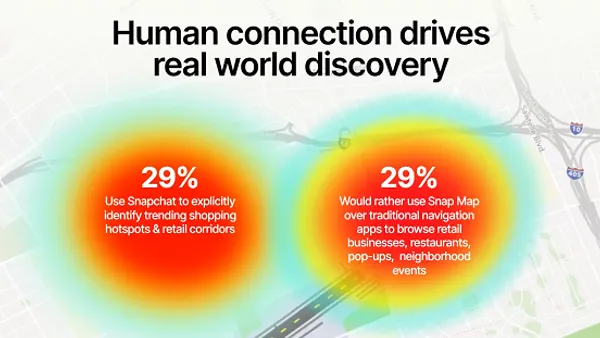
Snap has published a new report which highlights the value of Snap Map as a means to promote businesses as meet-up spots, with the company emphasizing the value of word-of-mouth recommendations via the app.
Yet, the report also shows that while Snap Map can help to drive discovery, most people refer to other map tools when looking for places to go.
Snap's data is based on a survey of more than 17,000 digital map users aged 13 to 44 across the U.S., Canada, the U.K., France, Germany and Saudi Arabia. Snap partnered with eye square and Horizon on the study, which shows how people are using various map tools to find new places.
First, the data showed that people are now using different map tools for different purposes, from direct intent to discovery.
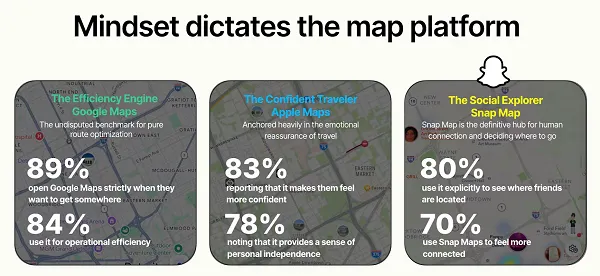
As outlined in this overview, people generally use Google Maps to find their way around, but they use Snap Map to find friends and maintain social connections.
Which makes sense, given that this type of information isn’t available on Google Maps or Apple Maps. But Snap said this is indicative of a broader mindset shift, which is important for marketers to note.
As per Snap: “To reach an audience that is universally browsing, gathering social proof, and deciding where to go, brands must look beyond utility maps and show up on social maps where consumers actively hang out and discover culture.”
Snap said that through features such as bookmarking, which enable users to highlight their favorite spots, Snap Map can provide more valuable discovery context and drive broader interest.
Indeed, Snap said that according to survey responses, consumers are 2.9 times more likely to say that they discovered their favorite real-world businesses on Snapchat versus other social platforms.
“Snapchat transforms the traditional map into an interactive canvas for social connection, where 76% consult Snap maps to see exactly where their friends are and 27% use it to directly coordinate face-to-face meetups,” the company said. “Snap Map, which reaches 450M global monthly active users, extends connection into the real world by helping people discover where life is happening, highlighting what’s happening nearby, and guiding people to explore culturally relevant places.”
Snap’s bottom line finding here is that Snap Map “creates a ripple effect where social discovery drives visits,” with that discovery process then driving more engagement.
Though that’s not the full picture of what the data shows.
For example, Snap highlights this finding to show that around a third of respondents indicated that they use Snap Map to discover businesses.
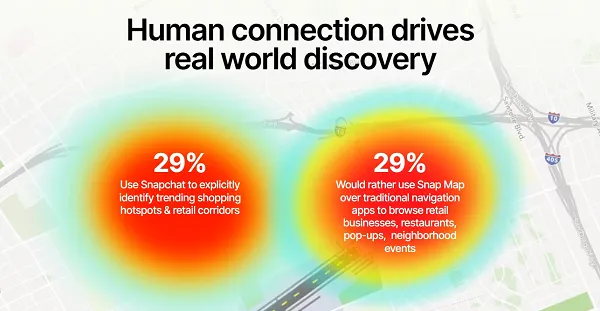
This is significant, because 29% of 17,000 map users is obviously a lot of people that are utilizing Snap Map. But this also suggests that more than 70% of people don’t use Snap Map for this purpose.
So while Snap is looking to showcase the value of Snap Map for discovery, it’s also inadvertently noting that people are primarily using other map tools to find information on businesses. Google lets businesses add a place listing on Google Maps, and based on Snap’s own reported findings, that may well be a more valuable focus for marketing and outreach efforts.
Though the Snapchat app does drive friend connection, and that can provide value in recommendations and social promotion.
It’s just that, by comparison, Snap Map usage is significantly lower than other map tools.
Snap said that the data shows that brands could benefit by incentivizing check-ins, and using its Promoted Places ad option to enhance connection. The company also said that enhancing brand listings on social maps can enhance overall performance.