Snapchat has published a new report which examines the evolving usage of artificial intelligence chatbots, and how the broader perception of AI tools is changing as more people use AI assistants in their day-to-day lives.
Based on a survey of more than 4,200 AI users conducted by Ipsos and WPP, Snapchat’s report shows that AI is becoming a more accepted, trusted partner for many people. The report found that AI is helping guide decision-making, including on product recommendations.
As per Snapchat: “The results are clear: AI adoption is massive, with 48% of consumers using AI daily and 50% of creators and marketers calling it a core part of their routine. “
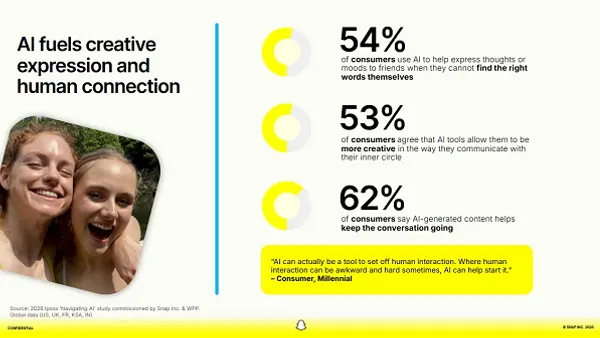
The data shows that most AI users felt that these tools helped them communicate more clearly and be more creative.
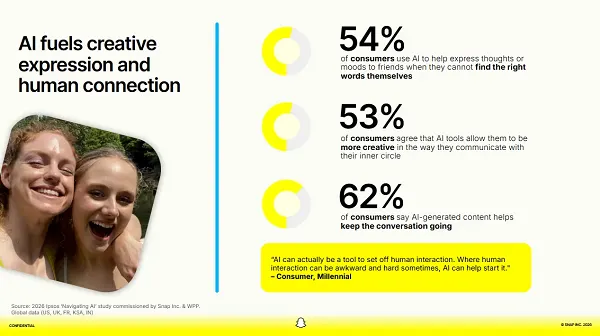
As shown in this overview, 62% of AI users said that AI tools help them maintain conversations, which indicated that more people are relying on AI to help guide their ideas and thoughts.
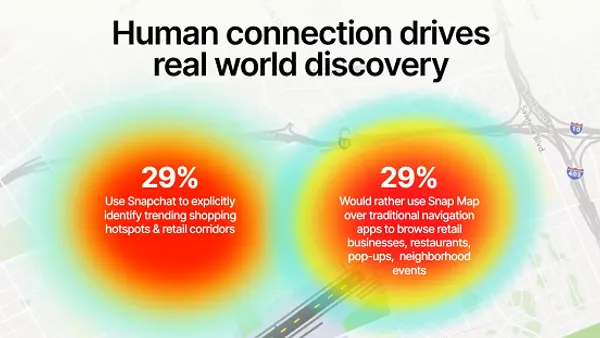
The data also showed that Snapchatters are 2.2 times more likely to agree that AI helps their social life and 1.6 times more likely to use AI to plan real-world activities.
As per Snapchat: “Over 80% describe [AI] as friendly and collaborative. Additionally, 74% view AI as a judgment-free space that can privately coach them in articulating complex feelings before sharing with peers.”
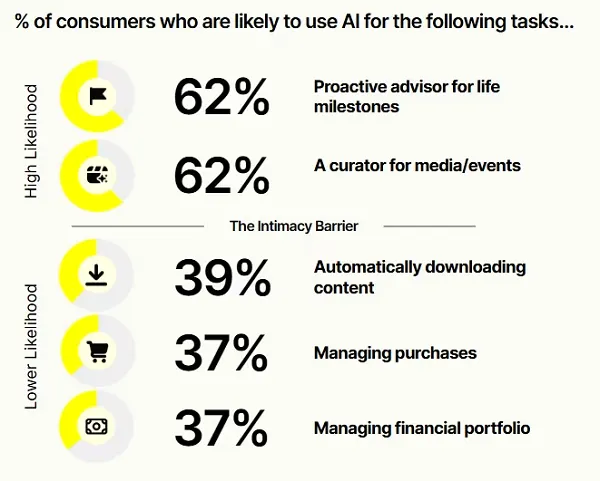
Though, as shown in this overview graphic, AI users still have reservations about using the technology to manage finances or make purchases.
But Snapchat says that this may be more flexible than many would expect.
“Privacy today isn’t an absolute — it’s a sliding scale,” the report said. “Consumers aren’t asking, ‘Is this private?’ They’re asking, ‘Is this worth it?’ The reality is that users will willingly trade data for personalized AI experiences when the immediate value is obvious. But that value exchange has boundaries.”
The idea that users will forgo privacy and security for utility has been a longstanding core of social media business. But it’s interesting to see Snapchat openly acknowledging this, and even promote it as a means for businesses to facilitate AI adoption. This essentially legitimizes data collection as a viable trade-off for providing valuable tools.
It probably shouldn’t be a trade-off, and this probably shouldn’t be an approach in driving adoption. But the logic is correct, as is apparent after decades of social media platforms taking in user data, which users have given over due to the utility of these apps.
Though Snapchat’s final point somewhat contradicts the same premise.
“70% of consumers find personal data used in hyper-personalized AI ads to be intrusive, and 56% consider 100% AI-generated content to be soulless,” the company said.
It’s an interesting dichotomy. On one hand, people are becoming more comfortable engaging with AI chatbots and tools, and sharing their personal data with these tools, so long as they feel beneficial.
Yet while Snapchat users feel that AI tools fuel their creativity in conversational form, many users view AI-generated content as empty and intrusive.
The takeaway seems to be that people are increasingly relying on AI tools for private chats, which help to guide their decision-making. But they’re less excited about their data being used to build targeted ads.
Which somewhat contradicts Snapchat’s suggestion that consumers are willing to trade privacy for value in other forms.