The platform formerly known as Twitter has lost some of the shine it had in its glory days.
Even so, X remains a key space for real-time discussions and debates. According to parent company SpaceX, the app serves about 550 million active users every month, with strong engagement rates across a broad range of communities.
Those communities could be valuable for marketing and promotions, and as such, X should remain part of any promotional ad spend.
But a lot has changed in the app, and marketers who want to make the most of X in 2026 can’t keep rolling out the same outdated tactics.
Nikita Bier, X’s head of product, has repeatedly discussed changes in the app’s focus that will impact reach, so brands that learn from what X is looking to incentivize will see better performance.
Here are some tips on how to build a presence on X in 2026.
Sign up to X Premium
Marketers should sign up for X Premium, and ideally X Premium+, to get full access to the platform’s marketing assistance features.
The basic X Premium package adds a checkmark to user profiles. This may not mean as much as it used to, but it is still seen as an indicator of legitimacy from some users. X Premium users also get a reply boost, which offers more exposure opportunities. In addition, brands will be able to access Media Studio, which is a central repository of brand assets and creative.
But X Premium+ is the better option for companies that can afford the higher monthly fees.
X Premium+ includes access to X Pro, which lets users track keyword mentions in real time, as well as monitor brand-relevant conversations. It also provides access to X’s powerful Radar tracking tool, which provides insights into conversation and mention velocity over time. The feature also offers a display of relevant posts for key terms, as well as artificial intelligence-powered trend data and information on top creators.
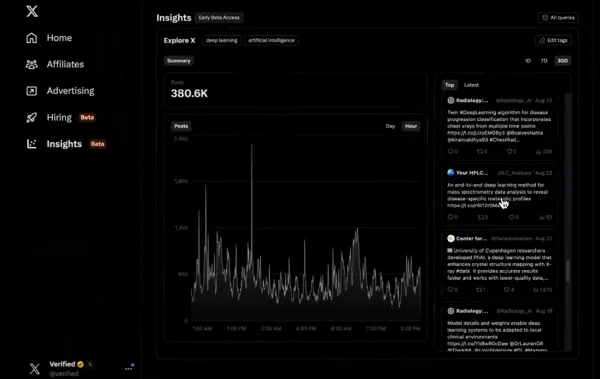
This is a key tool for brands that are serious about marketing on X, and the expanded data set can help contextualize in-app conversations.
Marketers can also ask X’s Grok chatbot for insights into key X trends in their niche and region. Grok is able to churn out detailed overviews of topical trends, including key influencers to check out.
Outline a strategy
Based on these insights, brands can build a full overview of relevant discussions in their niche, including trend notes and a list of potential influencers to reach.
Brands can then connect with these creators directly and partner on promotions, or use the creators’ audience data to build audience profiles.
It’s also helpful to take note of the content formats that resonate with a niche group, and see whether other brands use replies and/or DMs in their strategies.
X is working to boost engaging posts, and according to Bier this means brands that want to optimize their X post performance should post more descriptive updates. Doing this will give X users something to engage with, and it’s more effective than using X posts as a hook for links.
Bier said that providing more context in the post itself, or posting longer threads that summarize key points, will give creators more reach than posting link URLs alone. This is a change to historic X approaches, which used to encourage shorter captions to lead users to click.
Also, brands should avoid posting content that includes a watermark from another platform, because those posts incur a 90% reach penalty. X is also trying to reduce the reach of posts that include the word “breaking” in the intro.
Analyze and improve
Once a data-backed posting strategy is in place, brands will be able to monitor performance and refine their approaches based on engagement.
As always, marketers should ensure that their strategies are focused on the metrics that drive brand benefit and lead to sales actions or website visits. While the aims on this front will be different for each brand and campaign, it’s important to ensure that the data KPIs relate to brand goals, and are not focused on social media performance points.
Bots happen, likes are easy to earn and posting divisive hot takes is a low-effort way to get attention. Real brand strategy, however, means linking activity to actual outcomes. Reach may be good for brand awareness, but it’s less likely to increase referrals.
How marketers view X could come down to ideological perspective and how they feel about giving money to Elon Musk. But if X provides reach to a brand’s target market, then maybe remaining agnostic to platform politics should be a key driver of that approach.