YouTube has published a new report that looks at how creators are integrating artificial intelligence creation tools into their workflows, which also includes insights into AI usage trends among people who upload video content.
As part of its Culture & Trends series, YouTube commissioned NRG to survey nearly 700 people aged 14 to 44, who have posted a video online in the last 12 months, regarding their use of AI tools.
The data found that despite various concerns around the use of AI tools, more creators are integrating AI into their workflow in order to create new types of content.
As per the report: “Amid skepticism about the benefits of generative video, many are beginning to use it in a personal capacity. Surprisingly, in a U.S. study of people aged 14–44, 61% of people who have posted videos in the past 12 months said they were interested in using AI to insert themselves into video content.”
Which seems problematic. There are, of course, interesting and creative ways to remix video content or change the context. But adding a generative version of another person into a clip could also lead to misinformation, misleading depictions, or other potential issues.
According to YouTube, however, this was the most popular usage of its AI tools among the survey group, with more than two-thirds of people who’ve posted AI videos indicating that they featured themselves in their content.
“Adding yourself to AI content lets you play at being the director of your own life — making yourself the center of a comedy skit, or turning your family history into a period piece,” YouTube said.” A surprising 72% of uploaders (surveyed video posters aged 14–44) say they use AI on videos or images.”
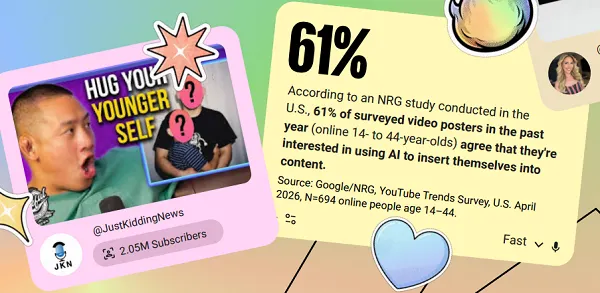
The report data showed that many people used generative AI tools to depict themselves in different times and roles.
“In one trend, people use these tools for digital costume changes, imagining themselves in many roles: a gym teacher becomes a doctor, judge, or superhero in the eyes of his students,” YouTube said. “A seemingly simple trend becomes a powerful statement on how people perceive themselves.”
YouTube also said that creators are using generative AI to discover fresh approaches to their personal passions.
“They can immerse themselves in cinematic scenes, double themselves for content creation, and turn their own sketches into photoreal mock-ups,” YouTube said. “In all three cases, they achieve a level of fidelity that was once beyond reach, sharing an elaborate vision that speaks to a much broader audience.”
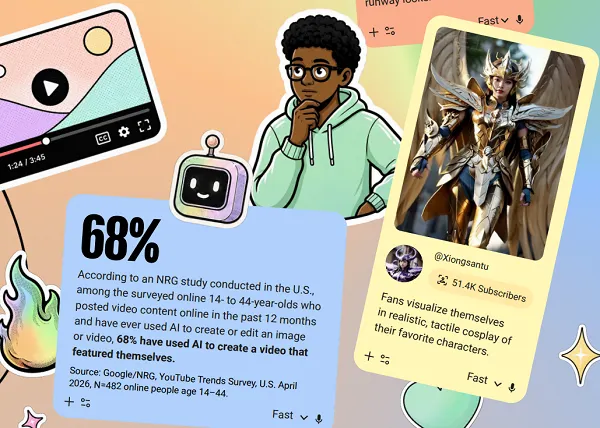
The data also found that aspiring fashion designers used AI to bring their concepts to life. Meanwhile, other creators inserted themselves into scenes from video games.
Some AI creators also used the technology to imagine entire cinematic worlds.
“Significantly, a review of the generative AI landscape reveals a new class of AI auteurs seizing the chance to bring whole cinematic universes out of their mind’s eye and onto the screen,” YouTube said.
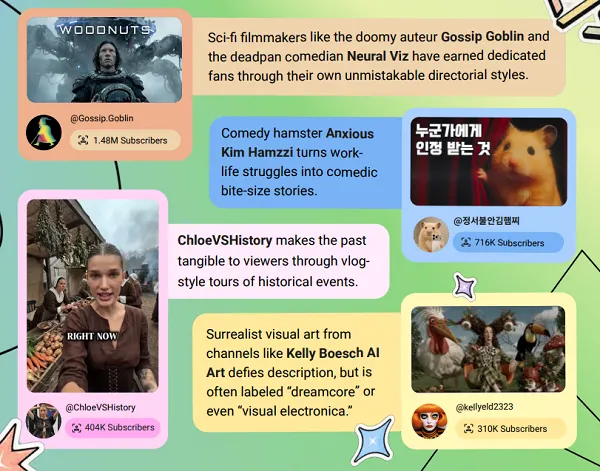
This is one way in which AI tools could be truly valuable, in enabling more creative expression and empowering the creation of concepts that otherwise may have been overlooked.
The challenge, then, is balancing the influx of AI slop with a much smaller percentage of valuable storytelling expansions. Whether the ends justify the means in this equation remains to be seen.